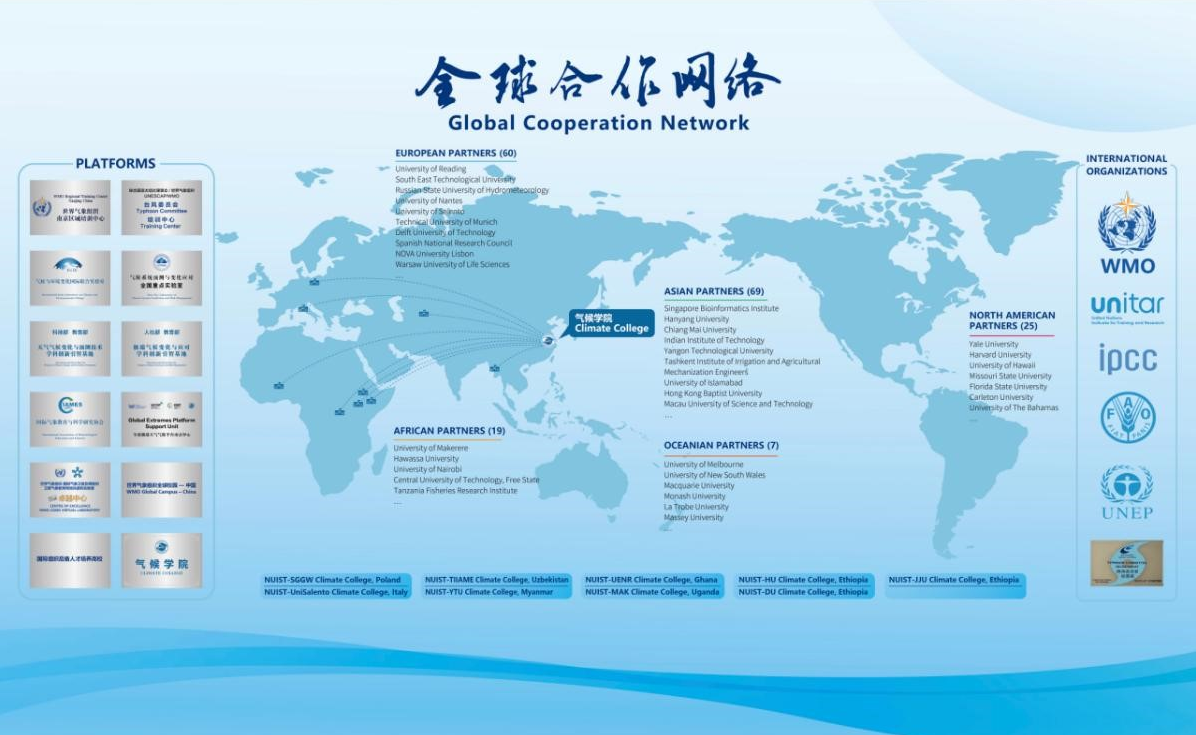
The NUIST Climate College network spans 9 colleges across 7 countries in Africa, Asia, and Europe.
The Climate College is a flagship international education and research platform launched by Nanjing University of Information Science and Technology (NUIST) in 2024. Built together with partner universities in climate-vulnerable regions, each Climate College is a jointly operated entity that integrates degree education, professional training, joint research and academic exchange — cultivating the local talent that countries need to anticipate, adapt to and respond to climate change.
As a 'Double First-Class' university in atmospheric sciences, NUIST initiated the Climate College under its “NUIST+” international cooperation model, aligning the university’s top-ranked discipline with the capacity-building priorities of Belt and Road partner countries and the Global South.
Cultivate interdisciplinary climate talent — from atmospheric science and hydrology to AI and disaster-risk management — for partner countries;
Train meteorological and hydrological professionals through practice-oriented, modular programmes;
Co-produce research on the climate challenges that matter most locally: drought, floods, food security, urban air quality and early warning;
Share China’s meteorological knowledge, technology and educational standards as global public goods.
By 2030, NUIST aims to grow the Climate College into a standardised, replicable model of climate education cooperation — expanding towards South Asia and Central & Eastern Europe, deepening joint research on regional challenges such as Aral Sea restoration, and contributing to the Belt and Road Initiative, the Global Development Initiative and global climate governance.
The Climate College builds on NUIST’s unique international assets:
WMO Regional Training Centre, Nanjing (est. 1993) — over 8,000 senior meteorological and hydrological professionals trained for more than 160 countries and regions; 14 alumni have become directors of national meteorological services or Permanent Representatives to the WMO;
The only university in China holding IPCC observer status, contributing to the Seventh Assessment Report cycle;
Home to the ESCAP/WMO Typhoon Committee Training Centre and a founding member of the International Association of Meteorological Education and Sciences (IAMES).
Every Climate College operates on a 'four-joint' framework: joint disciplines, joint talent cultivation, joint research and joint resource sharing, with faculty and facilities committed by both partners.
Dimension | Mechanism |
Degree education | Full-chain dual-degree pathways: “2+2” undergraduate, “1+1” / “2+0” master’s, “1+3” / “2+2” / “3+1” doctoral |
Scholarships | NUIST Climate College Scholarship — covering tuition, accommodation, living costs and insurance |
Global training | Demand-driven modular courses delivered in China and in partner countries, via the WMO Regional Training Centre, Nanjing |
Joint research | Joint laboratories and co-led international projects |